For about a year, I pitched versions of the same novel product idea to one stakeholder after another. We were stuck in a loop of pitching the same idea with more polish and more details, and always getting the same answer: “Good, but what about that other thing?”
A concept pitch became a comprehensive product vision. The expectation was to have an answer for every possible question even before all the questions were known. So instead of being scrappy and directional, we tried to be exhaustive and perfect.
Some of that work was good and I'm still proud of it, but I disagreed with how we spent the year. Here are some of my thoughts on why we failed.
A rough sketch of how we spent our time, and how we should have.
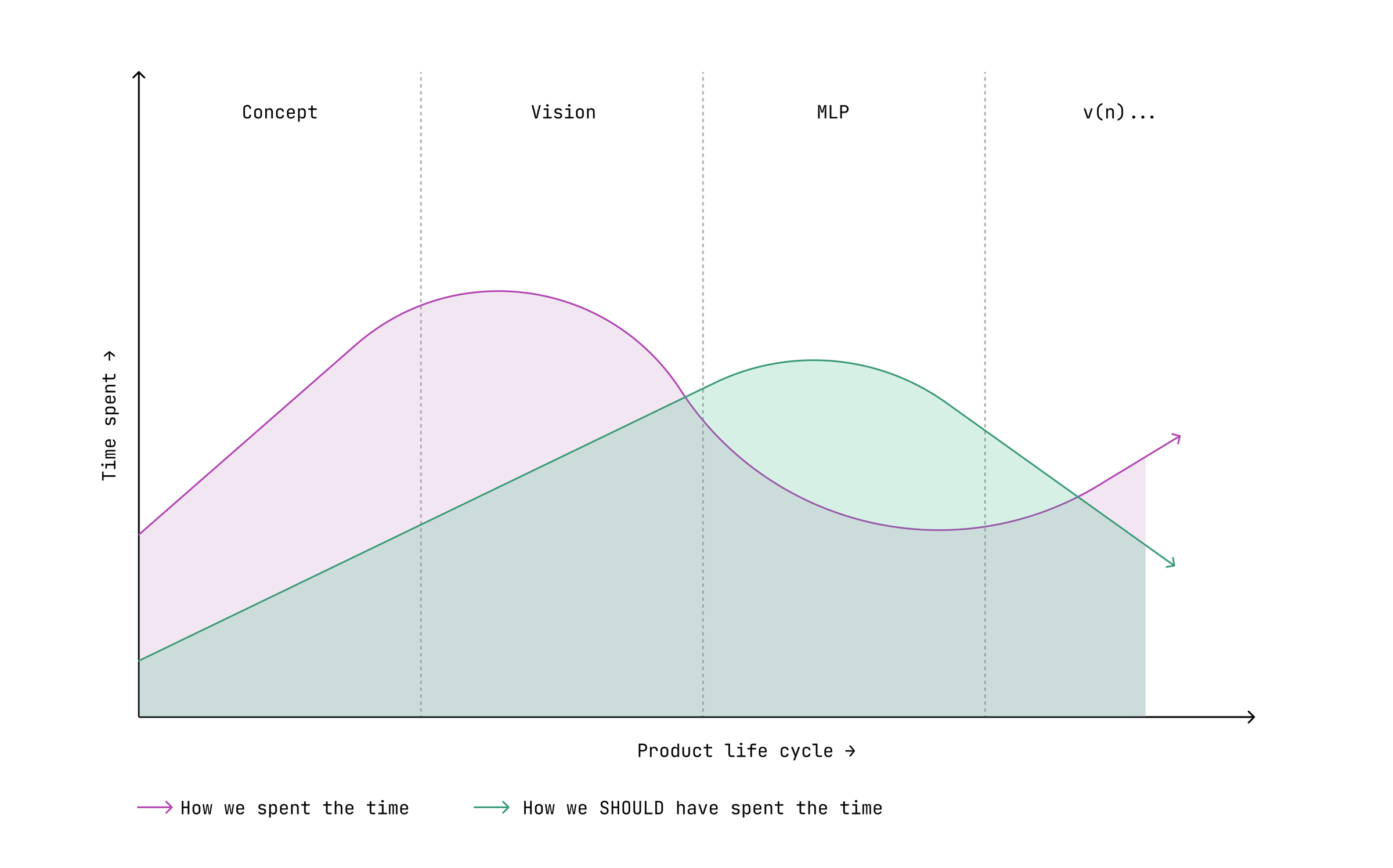
Advice on UX vision is well understood and known. Scrappy, directional, don't polish it! It is remarkably consistent, and it has been for a long time (see references).
So despite being aware of this, why did we run massive design sprints that ended up in an artifact rather than influencing the product direction?
My hypothesis is:
- Incentives and ownership: A vision deck is the most visible piece of design work there is. It gives its authors a “thought leadership” wild card, even when it does not meaningfully influence the product direction. In technical domains especially, UX can claim that credit just by producing the artifact, without the accountability of translating the vision into a product roadmap.
- Risk-averse system: Large organizations are incentivized to be risk averse, because incremental change keeps the elephant moving. Doing something dramatically different takes either strong conviction or strong pressure. Without either, they keep asking for more detail, deferring the decision while camouflaging it as diligence, and every request becomes another round of crafting the vision.
- Lack of business acumen and technical understanding among UXers: When UX teams lack technical depth and business understanding, they often build stronger walls around themselves instead of breaking the existing ones, mistaking themselves for the sole custodians of user needs. Unable to argue for direction in the terms the room actually decides on, they compete on the one thing they own, craft, and more polish becomes a substitute for a better argument.
It wasn't only that we asked the wrong questions; it was that we asked them at the wrong time. A vision has one job: to change the conversation from “should we build this” to “how do we build this”. Everything beyond that is polish.
Industry advice on UX visions
- Bill Buxton: getting the right design comes before getting the design right, and they are different activities. (Sketching User Experiences, 2007)
- Marty Cagan: a visiontype captures only the core concepts of an idea. It isn't meant to be complete, and it isn't a spec. (Visiontyping and the Hands-On Executive, 2009)
- Brian de Haaff and Henrik Kniberg: aim for the earliest lovable thing, not the minimum viable one. (The minimum lovable product, 2013; Making sense of MVP, 2016)
- Julie Zhuo: a north star is not a spec, a roadmap, or a set of mocks. Don't work backwards from the picture; work forwards from today and validate the most controversial parts first. (Design's North Star, 2014)
- Daniel Ruston: a vision needs a small, dedicated team with decision-makers in the room, and iteration on its own is not innovation. (Design for a Vision, Google Design, 2018)
- Josh Sassoon: visioning is a practice, not a project. Solo sprints of one to three weeks, stories before visuals, a deliberately different UI kit so the concept is judged on its own terms. (A practical guide to design visioning, 2018)
- Jared Spool: an experience vision describes the experience, not the design or the technology, and sits far enough out that today's constraints stop being the subject. (The 3 steps for creating an experience vision, 2018)
- Steve Blank: organizations swap product for process and call the result innovation. (Why companies do innovation theater, 2019)