The best way to judge a chair is to sit in it. With AI, I can get to a comfortable enough chair in a few minutes. From the outside every decision in it looks deliberate, when only some of them were. As I iterate, it gets harder to differentiate my decisions from the ones AI assumed.
I find myself settling on the shape of a solution before I've considered enough alternatives. This made me think about what I skip when I settle early, and why.
1. Hidden costs of cheap code
The tools we use and the order we use them in, are changing rapidly. My old order was roughly: sketch/notes → flow → polish → code. It worked because reversibility decreased as effort increased. Design iterations were relatively cheap, but code was expensive, so code only came after design was validated.
With AI, while building is cheap, discarding it is still NOT.
AI now gets me to a prototype that's about 70% finished, cheaply. It is good enough to show, but is rough enough to be wrong. This is a dangerous place to linger. Changing direction is harder here because polishing a 70% prototype feels like progress even when conceptual exploration has prematurely collapsed.
2. Tools shape process as much as process shapes the tools
This new way of building made me realize my discipline was not entirely my own, materials and tools play a critical role in helping me follow the process. Pen and paper naturally limit depth, which nudges me toward breadth.
AI tools enforce none of that, and are optimized for faster progress instead. So the constraints have to be something I add, deliberately slowing the process down.
I map this on two axes, behavioral (function) and visual (form) fidelity. My new process looks like jagged loops expanding out from the 70%-middle. You can start anywhere, but skipping a quadrant always comes at a cost. Pushing into the corners earns me insights that the comfortable enough chair hides.
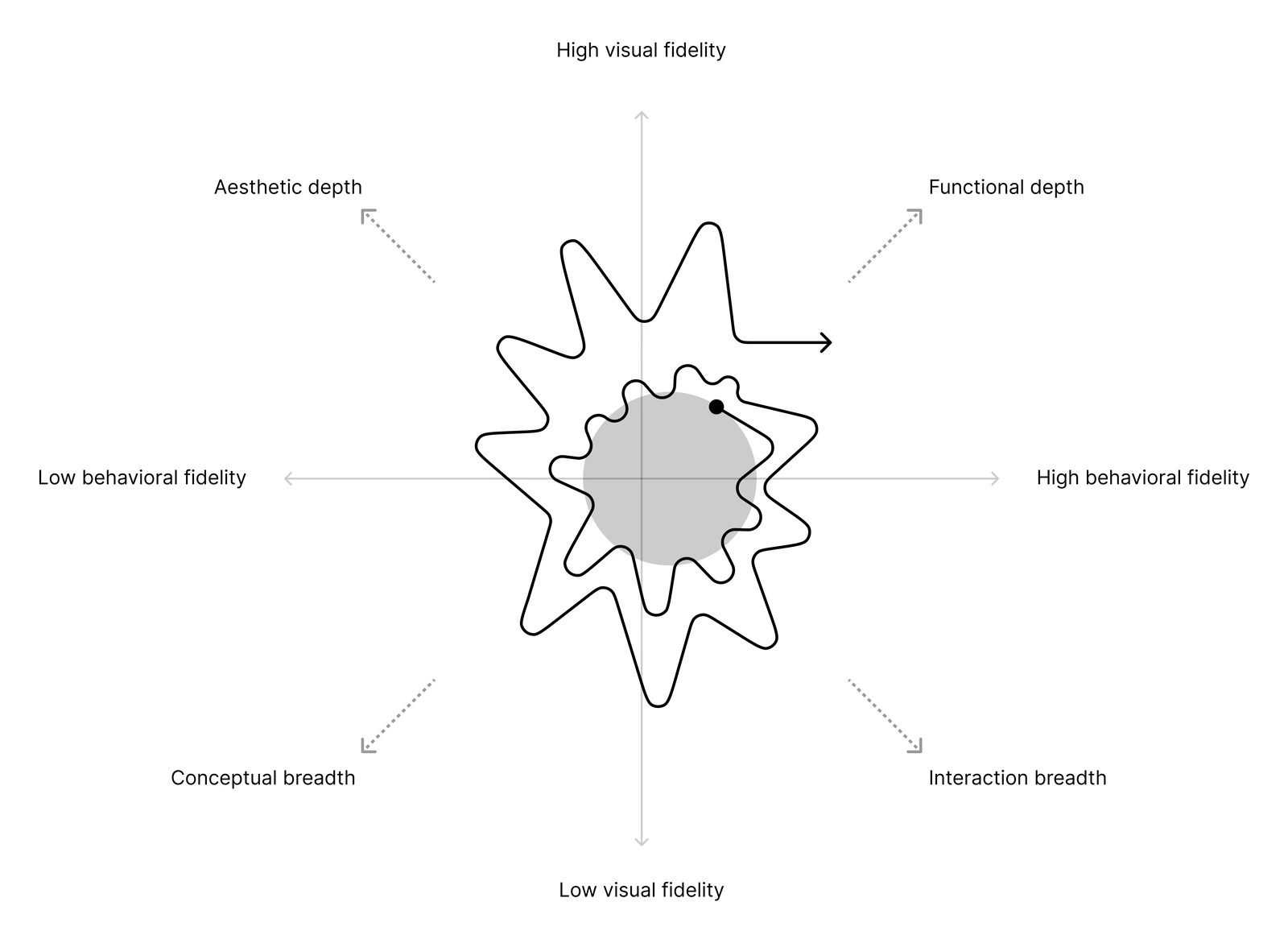
3. Importance of specialized tools
Claude Code recently added design capabilities, and I keep expecting these agents to shrink the number of tools I use. So far they haven't. I still reach for specialized tools alongside them to push into the corners.
Any digital solution I design has two primary dimensions:
- Visual fidelity (Form): craft, brand cohesion, design system alignment
- Behavioral fidelity (Function): interaction completeness, functional reality, live data integration
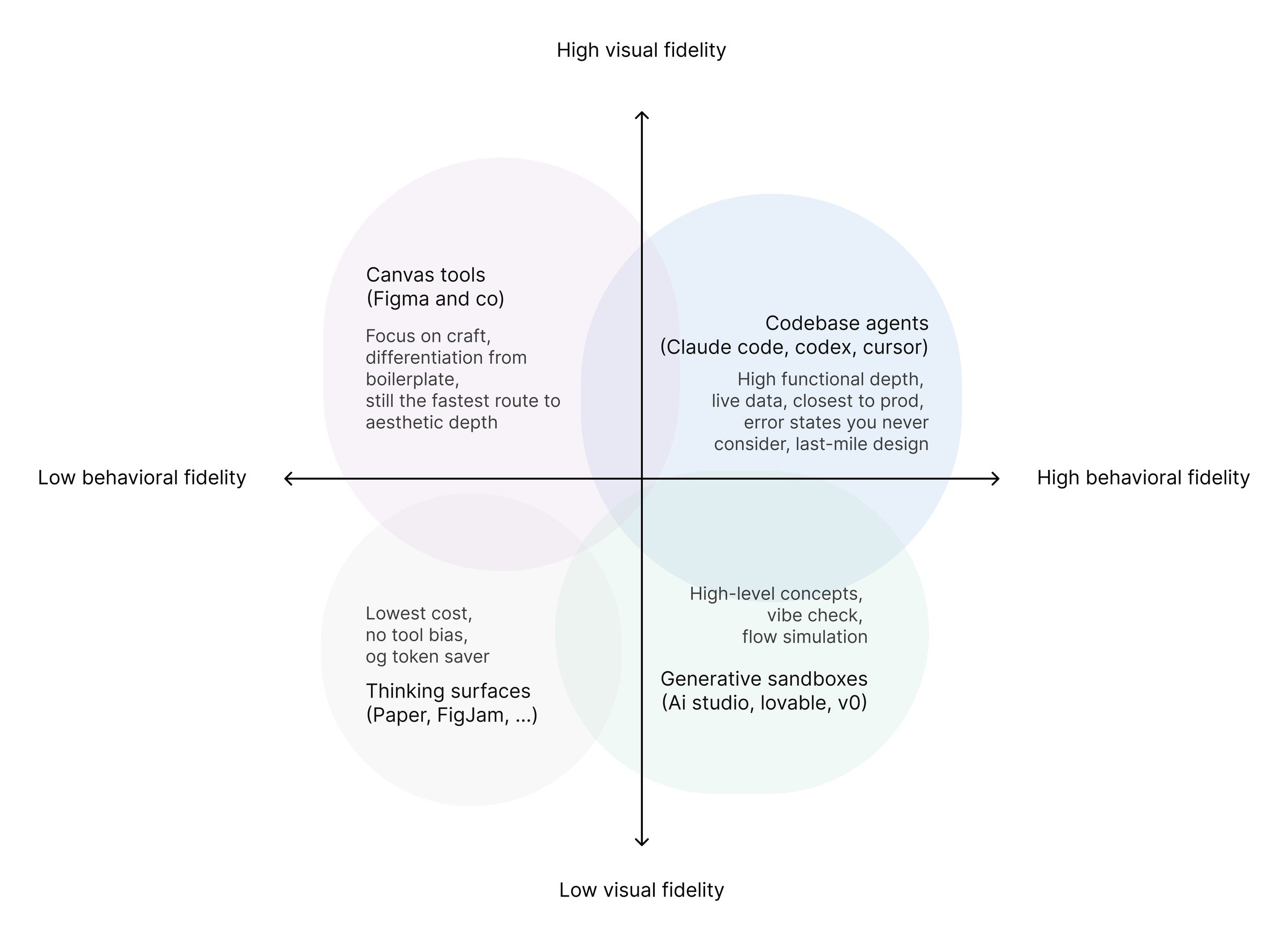
Each quadrant of those two axes solves for a different parameter of quality, and the tools that serve one well are usually the ones that struggle elsewhere, which is the point rather than a shortcoming.
To explore aesthetic depth I use a tool that is strong at visual fidelity and poor at behavior, like Figma. AI Studio is the reverse, excellent at shallow functional flows and unable to go deep in either direction, which makes it a good choice for quick sandboxed prototypes to test user flows.
Before, I used to design in order to build. Now, I mostly build in order to design. The tools and the order of operations changed faster than my habits did, and I'm still figuring out which of those habits were actually mine and which ones were the paper doing the work.